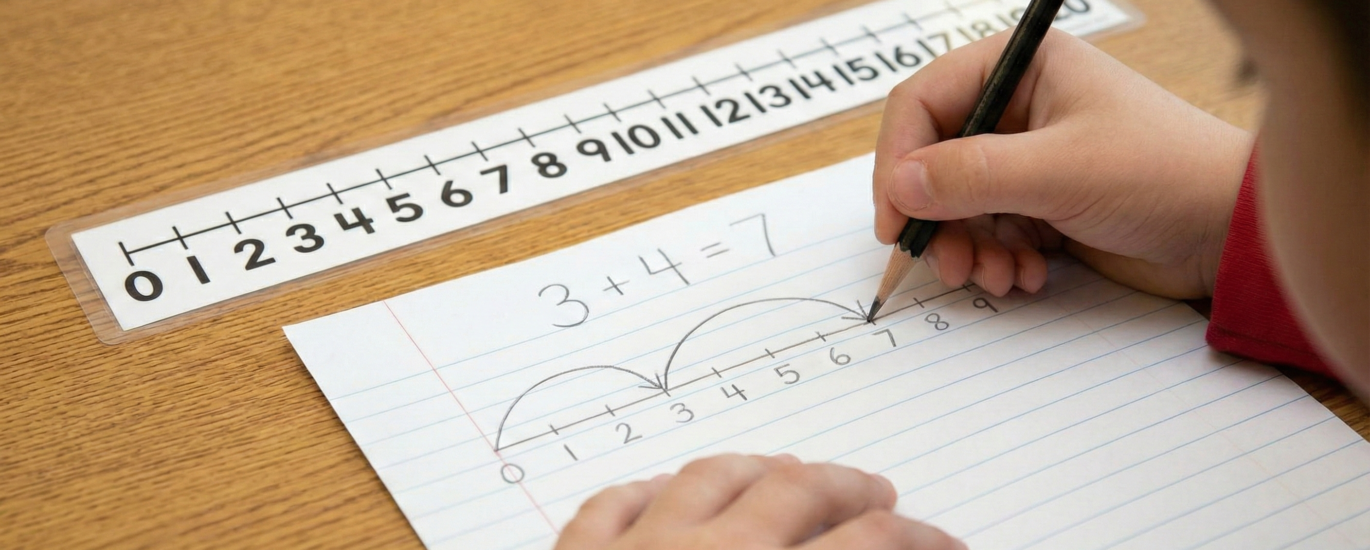
Number lines hang above chalkboards in almost every classroom, yet they remain one of the most underused mathematical tools in elementary education. As Jeff Frykholm reminds us in Learning to Think Mathematically with the Number Line, a number line is far more than a counting aid. It is a powerful model that strengthens number sense, supports flexible thinking, and helps children build lasting mental strategies.
Many familiar manipulatives such as hundreds charts or fraction circles offer visual support but often limit flexibility. Hundreds charts can interrupt the natural flow of numbers, leading students to rely on inefficient counting strategies. Fraction circles show parts of a whole, but their static nature makes it harder for learners to visualise the continuous, proportional relationships that are so important when working with fractions.
The number line, by contrast, offers something fundamentally different. While blocks and counters show numbers as sets of objects, a number line shows numbers along a continuous path. This helps children understand:
- How numbers are ordered
- How far apart numbers are
- How numbers grow
- How operations move us along this path
The Magic of the Open Number Line
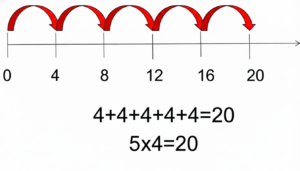
The open number line invites children to think, not just follow procedures. With no fixed markings, students place numbers themselves, estimate distances, make “friendly” jumps, and see patterns emerge naturally. This flexible tool encourages reasoning and mental-math strength. Tasks like showing how far 36 is from 50, or representing 5×4 = 20 on an open number line can help children visualize relationships and develop their own strategies, rather than relying on memorized steps.
How I Use Number Lines in My Teaching
In my sessions, the number line is one of the most powerful thinking tools I give students. Whether I’m working with kindergarteners learning numbers to 20 or older students exploring multi-step operations, the number line helps them see the math.
I use open number lines to:
- model how to record thinking
- encourage students to choose efficient strategies
- build comfort with friendly numbers and landmark jumps
- support students in creating their own number lines to show reasoning
For many learners, especially those who feel anxious with rigid algorithms, the number line becomes a safe, visual space to test ideas and make sense of operations. It aligns deeply with my teaching philosophy of empowering students to think like mathematicians, communicate their reasoning, and develop a strong, conceptual foundation.
A Pathway to Mathematical Confidence
Ultimately, a number line is far more than a ruler. It is a mental map for the entire number system; one that turns abstract ideas into visual, meaningful movements. When children jump along a number line, they engage their intuition, clarify their thinking, and begin to see the logic behind the math.