Math doesn’t have to begin with worksheets or end with memorizing steps. Some of the richest learning happens through stories, the ones children hear, read, and even create themselves. When kids engage with stories, they connect math to real-life situations, characters, emotions, and choices. This naturally deepens understanding, because children aren’t just solving problems, they’re imagining what could happen next, exploring possibilities, and reasoning through ideas that feel meaningful to them.
Stories allow children to see math. “The squirrel gathered 8 acorns and found 3 more, how many now?” becomes far more powerful than simply writing “8 + 3.” Through settings, characters, and tiny conflicts, children make sense of addition, subtraction, grouping, sharing, measurement, or even fractions. Older elementary learners can weave math into stories about saving money, buying tickets, dividing pizza, or planning a trip—suddenly operations have real purpose.
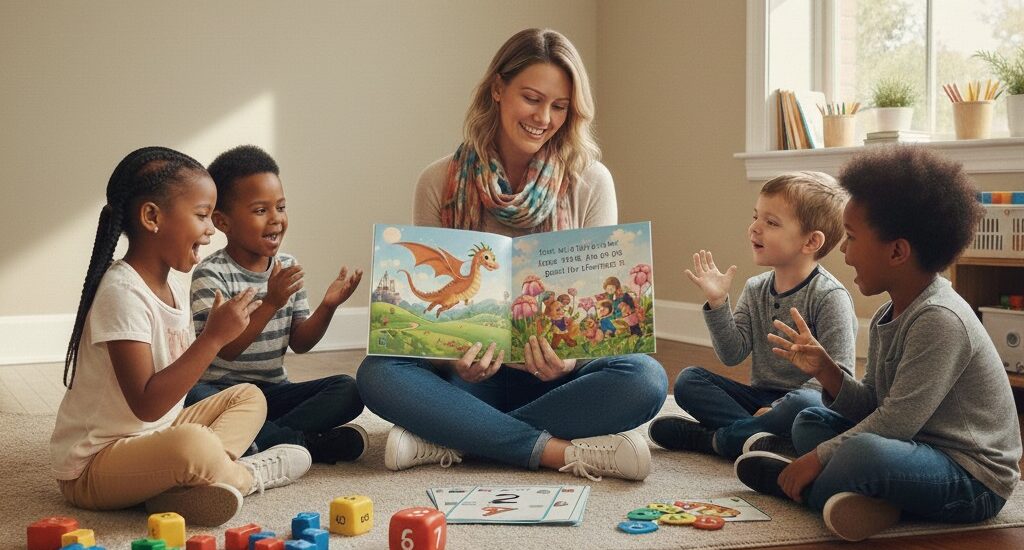
In my Math Xplorers : Storytime Edition class, stories are at the heart of learning. We use beautifully illustrated books to introduce concepts like patterns, skip-counting, place value, symmetry, fractions, and data. Children listen, predict, notice details, and then explore the math hidden inside the story. A book about building becomes a lesson on shapes and arrays; a story about cookies turns into fair sharing; a tale about animals migrating becomes a chance to explore number patterns on a number line. The story draws them in, the math helps them think deeply.
One of the most effective strategies that works well in my math sessions is inviting children to write their own math stories. The journey begins together, choosing a character and a small problem to explore. Students then start creating their own stories sometimes with a partner, sometimes with guidance before gradually moving towards independent story telling. This approach helps them become problem creators, not just problem solvers strengthening reasoning, communication, and confidence along the way.
Parents can similarly bring math to life at home by turning everyday moments into playful learning opportunities. Car rides for example can become lessons in counting and recording data. Children can tally passing cars, types of vehicles or colors, turning observation into meaningful math practice. Bedtime stories can become playful math adventures, with number in the plot tweaked or questions like, “What if there were three more …? inviting children to think creatively. A shopping trip can become a story full of numbers – calculating totals, comparing prices or figuring out how many items are needed. Through these activities, children see that math isn’t just about worksheets, it’s a vibrant part of the everyday world waiting to be explored.
Math through stories is joyful, imaginative, and memorable. It helps children realize that math isn’t something imposed on them, but a subject that truly grows from their own thinking and ideas. Most importantly, it nurtures the belief that every child is a storyteller, and every storyteller is already a mathematician.