“When will I ever use this?” and “Why am I learning this?” are questions I hear often in my math sessions. Sometimes they are asked with curiosity, sometimes with frustration, but always with honesty. At the heart of these questions is a search for meaning. Students want to know that what they are learning matters. When we help them see connections between math and everyday life, math shifts from being a school subject to becoming a useful, lasting skill.
One of my most important goals as a math educator is to help children develop a positive math identity. I want students to feel that they can do math, that it makes sense, and that it belongs to them. When math is presented as a set of disconnected exercises or worksheet routines, it can feel abstract and intimidating. But when it is woven into familiar experiences such as food, games, sports, architecture, shopping, and stories, students begin to see themselves as capable problem solvers. Math becomes something they use, not something that is done to them.
Math Through Architecture
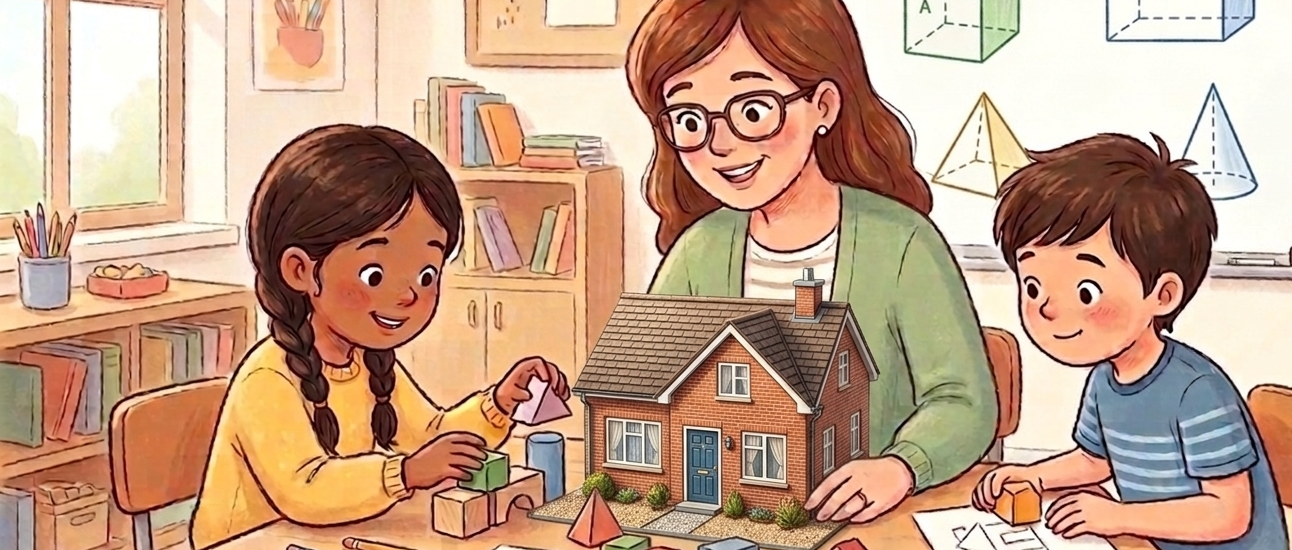
I often draw on my background as an architect to show how math exists all around us. Even young learners can connect to ideas about shapes and angles when they see them in the real world.
For example, when we explore angles, we begin with what students can see and touch. I might ask them to spot the angle where two sides of a roof meet or compare which roof appears steeper or flatter. We might observe how a ball rolls down a ramp depending on the angle.
Three-dimensional shapes also become easier to understand when connected to real structures. A cylinder becomes a water tank, a triangular prism becomes a roof, and a cube can resemble a small building. Shapes are no longer just diagrams in a textbook. They are functional, visible, and meaningful. By noticing and comparing angles, shapes, and spaces, students begin to understand how math helps us design, build, and create.
Math in the Kitchen
The kitchen is one of the richest classrooms for learning math. Cooking naturally introduces measurement, estimation, ratios, scaling, timing, sequencing, and division. When children measure ingredients, compare quantities, or divide dough, they are strengthening their number sense in a hands on and memorable way. Fractions stop being abstract symbols and become half a cup, a quarter of a pizza, or three quarters of a bowl. Because food is meaningful and sensory, the learning stays with them.
Math in Sports, Play, and Games
Sports and games offer powerful opportunities for students to see math in action. Math appears in scores, timing, speed, angles, patterns, strategy, and probability. In my sessions, I often use card games and board games to bring these ideas to life. Counting moves, keeping score, spotting patterns, and planning strategies all involve mathematical thinking, often in ways that feel like play rather than work. Games encourage students to reason, make predictions, and compare options.
When students analyze a scoreboard, calculate how many points are needed to win, or plan their next move in a game, they are applying math skills in real time. Math becomes active. It moves. It competes. It matters.
Discovering Hidden Math in Everyday Images
One activity I enjoy using in my sessions is showing students a simple photograph from everyday life such as baking cookies, arranging books on a shelf, setting up a badminton net, organizing a cupboard, or working on a design project. Instead of giving students a direct prompt, we begin by exploring the image together and looking closely at what is happening in the scene. At first, students simply describe what they see. But as we keep observing, they notice the hidden math within the picture. They spot equal groups in rows of cookies, fractions in sliced fruit, symmetry in patterns, measurement in spacing, angles in sports equipment, ratios in recipes, and area in floor plans.
This simple routine helps students develop what I call a mathematical eye, the ability to notice patterns, quantities, relationships, and structure in the world around them. Over time, they begin spotting these ideas independently. That is when true ownership of learning begins.
Making Math Conversations Part of Everyday Life
Parents can support this connection making at home through simple everyday interactions. During daily activities, pausing and inviting children to think about numbers, patterns and quantities around them can spark meaningful conversations. For example, while setting the table, a parent might ask, “Do we have enough plates for everyone?” or “Which container do you think holds more?” While baking they might notice together how the cookies are arranged or ask, “Can you spot the pattern here?”. These small gentle questions help children see math naturally in what they are already doing. Children can begin to see math in a playground, during a family meal, at the grocery store, while watching a sports scoreboard, or while playing a board game. These natural conversations help reinforce an important idea that math is not separate from daily life. It is already all around us.
From Question to Invitation
When students ask, “When will I ever use this?” it is not a challenge but an invitation to make learning meaningful. It is an opportunity to show them that math lives in kitchens, on sports fields, in buildings, in games, and in everyday routines. When we intentionally build these connections, we do more than improve understanding. We shape identity. We help students see themselves as thinkers, designers, strategists, and problem solvers.
Math is not just numbers on a worksheet. It is a language for understanding the world. And when students recognize that, everything changes.